Sauna Heater Sizing Guide UK 2026: kW per Cubic Metre
Sauna heater sizing: how to calculate the right kW for your cabin volume, what adjustments to make for glass walls and external location, common mistakes.
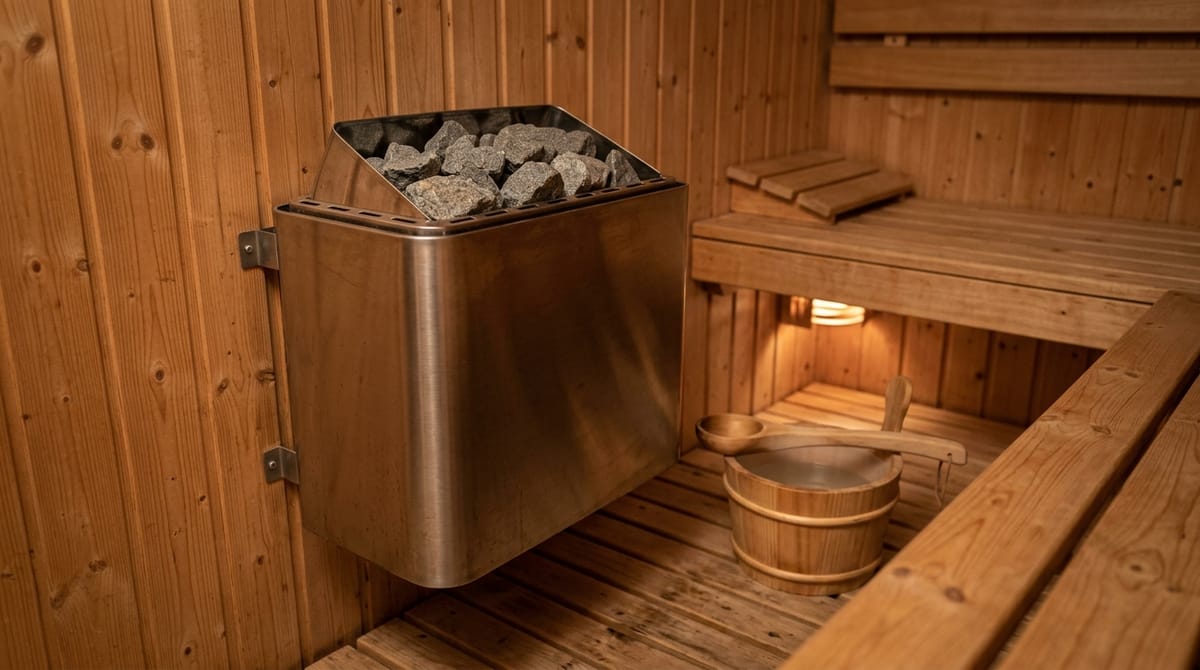
If you're spec'ing a sauna heater for a home cabin, getting the kW rating right is one of the most important decisions you make. Undersized heaters never get the cabin to proper sauna temperature; oversized ones cycle on/off, waste energy, and produce uneven heat. This guide walks through the standard sizing formula, the adjustments that matter, and the common mistakes to avoid.
The 1 kW per cubic metre baseline
Industry-standard rule of thumb - works for most indoor wood-panelled cabins.
The starting point: 1 kW of heater power per cubic metre of cabin volume. Cabin volume = length × width × height (in metres). This formula assumes:
- Standard Finnish wood-panel interior on all walls + ceiling.
- Indoor location (heated building, not external).
- Standard sauna ceiling height (2.1-2.3 m).
- Target temperature of 80-90°C with löyly capability.
For a typical 1.8m × 1.5m × 2.1m two-person home sauna, that's 5.67 m³ → 5.7 kW heater minimum. The standard 6 kW Harvia / Tylo / Narvi unit covers this with a small safety margin.
For a 2.0m × 2.0m × 2.1m four-person family sauna, that's 8.4 m³ → 8.4 kW heater minimum. A standard 8 or 9 kW unit is appropriate.
When to size up
Five conditions that need more kW than the baseline.
1. Glass walls or large viewing windows. Glass loses heat much faster than wood. Standard adjustment: add 1.5-2 m³ of 'effective volume' for every m² of glass wall or window. A sauna with a full-glass front (3-4 m²) needs an additional 5-8 kW of heating capacity over the basic volume calculation.
2. External / outdoor location. Sauna cabins located outdoors (garden saunas, summerhouse conversions) lose heat to the outside environment faster than indoor cabins. Add 20-30% to the baseline kW. A 6 m³ outdoor cabin needs ~8 kW rather than 6.
3. Unheated installation area. Indoor cabins sited in unheated garages, sheds, or unconditioned outbuildings behave more like outdoor cabins for sizing purposes. Add 15-25%.
4. High ceiling. If your sauna ceiling exceeds the standard 2.3m, the heat-stratification effect (hot air rises) means the upper bench is fine but the lower bench is cool. Either insulate the upper space, lower the effective ceiling height with a false ceiling, or oversize the heater 15-20% to compensate.
5. Stone-heavy heater design. Heaters with very large stone capacity (Saunum saunas, large Tylo Sport models) hold more thermal mass and benefit from being slightly oversized to maintain temperature during heavy löyly cycles. Add 10-15% to the baseline for these designs.
Why undersized heaters fail
The most common mistake + what it actually does to the sauna experience.
The classic mistake is going one heater size down to save on the electrical install cost (lower-kW heaters can run on 16A single-phase circuits; higher-kW units need 3-phase). What happens:
- Long warm-up times. A 4.5 kW heater in a 6 m³ cabin will take 90+ minutes to reach 80°C, vs 30-40 minutes for a properly-sized 6 kW unit.
- Cabin doesn't reach proper Finnish temperature. Undersized heaters cap out around 65-75°C - hot enough to sweat in but not a proper Finnish sauna experience. Löyly bursts cool the air faster than the heater can re-heat it.
- Higher energy consumption per session. The undersized heater runs at 100% output for the entire warm-up + session, vs the properly-sized one cycling on/off. Total kWh per session is higher.
- Stones never get hot enough for löyly. Below ~250°C, water on the stones produces dribbles rather than steam bursts. The defining feature of a Finnish sauna is lost.
The right move is to spec the heater first based on cabin volume + adjustments, then plan the electrical install around it - not the other way around.
Worked sizing examples
Three typical UK home-sauna setups.
Example 1: Small indoor 2-person sauna (no glass)
- Cabin dimensions: 1.8m × 1.5m × 2.1m = 5.67 m³
- No adjustments needed (indoor, standard ceiling, wood interior).
- Heater: 6 kW (Harvia Vega 6kW, Tylo Sense Combi 6kW, Narvi 6kW).
- Electrical: 32A dedicated single-phase circuit.
Example 2: Outdoor 4-person garden sauna with 2m² glass door
- Cabin dimensions: 2.0m × 2.0m × 2.1m = 8.4 m³
- Glass adjustment: +3 m³ effective (2m² glass × 1.5)
- Outdoor adjustment: +20% → effective volume 13.7 m³
- Heater: 13.5-15 kW (Harvia Cilindro 13.5kW, Tylo Sport 14kW, Narvi NM 13.5kW).
- Electrical: 3-phase 400V 25A supply required.
Example 3: Cellar conversion with insulated walls (no glass)
- Cabin dimensions: 2.4m × 1.8m × 2.2m = 9.5 m³
- No adjustments needed (insulated indoor space).
- Heater: 9 kW (Harvia Vega 9kW or equivalent).
- Electrical: 3-phase 400V 16A supply.
Heater types: wood-fired vs electric
Sizing logic transfers - power source doesn't change the volume calculation.
The 1 kW/m³ rule applies to electric heaters specifically. Wood-fired heaters are rated differently (in heating capacity by cabin volume directly) but the underlying volume calculation is the same. Manufacturer specs translate between the two:
- A 'wood-fired heater for 6-12 m³ cabins' is approximately equivalent to a 6-12 kW electric heater for the same volume.
- Wood-fired heaters generally have higher peak output (better for big löyly cycles) but slower warm-up and require active fire management throughout the session.
- For UK home buyers, electric is the more common choice unless you have a chimney pre-installed (most outbuilding conversions don't).
See our home sauna buying guide for the wider category considerations including heater type selection.